
Cronitor Alternative
Cronitor specializes in cron-job monitoring with per-monitor + per-user pricing, and charges separately for branded ($25/mo) and private ($50/mo) status pages. DiagnoSEO bundles cron, uptime, SSL, domain, DNS and SEO into a single flat plan.
Try DiagnoSEO Uptime Monitoring →
Why people look for a Cronitor alternative
Cronitor started as a focused cron-job monitoring tool in 2014 and remains one of the strongest options in that category. Heartbeat URLs, ping-based monitoring, instant alerts when jobs fail or run late. Over time the product expanded to website uptime, RUM, and hosted status pages — but the pricing model still betrays its cron-monitoring origin.
Where it stops being a good fit:
- Per-monitor + per-user pricing. Business plan is $2/monitor + $5/user. For a team of 5 monitoring 50 endpoints, the monthly bill lands around $125 just for monitor capacity. A team of 10 monitoring 100 endpoints climbs further.
- Status pages are paid add-ons. Branded status pages are $25/mo extra; private (password-protected) pages are $50/mo. Most uptime tools in the same price range bundle status pages.
- SSL / domain / DNS coverage is thin. Cronitor does HTTP uptime checks with response assertions. SSL expiry warnings exist; WHOIS-based domain expiry tracking and full DNS A/MX/NS diff are not the core product.
- No SEO framing. Keyword presence checks are possible via response-body assertions but there is no SEO infrastructure positioning — no backlink monitoring, no referring-domain tracking, no SEO suite cross-sell.
- Free tier is limited to 5 monitors. Useful for evaluation; not enough for any real production setup.
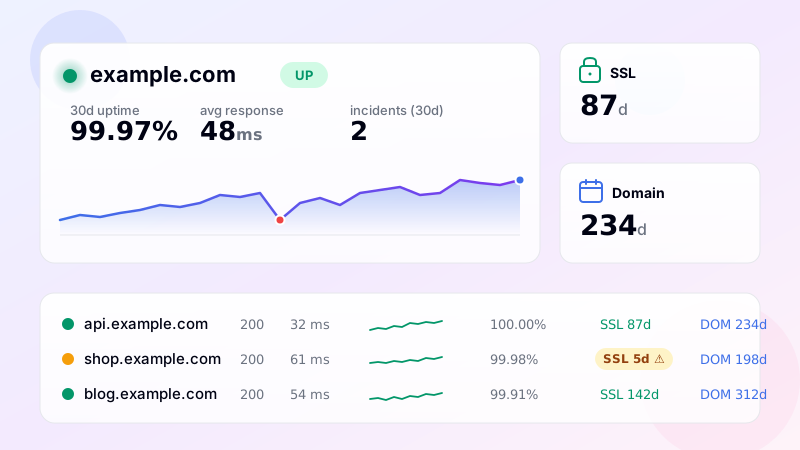
DiagnoSEO Uptime Monitoring takes the opposite approach: flat per-month pricing with monitors included in the plan tier, status pages bundled when they ship, full SSL/domain/DNS coverage, and SEO suite features (backlinks, keyword tracking) baked in.
Feature comparison
| Feature | DiagnoSEO | Cronitor |
|---|---|---|
| Free plan | 5 monitors (preview) | 5 monitors |
| Entry paid pricing | From $7/mo (flat) | From $20/mo (20 monitors) |
| Pricing model | Plan tier | $2/monitor + $5/user (Business) |
| Minimum check interval | 1 minute (Pro+) | 1 minute |
| Multi-region checks | 13 regions | Multi-region |
| Cron / heartbeat monitoring | ✅ Included | ✅ Core product |
| SSL expiry alerts | ✅ 30/14/7/3/1d | ✅ |
| Domain expiry tracking | ✅ Included | ❌ |
| DNS change detection | ✅ Full diff | ⚠️ Partial |
| Keyword presence/absence checks | ✅ | ⚠️ Response assertion |
| JSON assertions for APIs | ✅ | ✅ |
| Hosted status pages | Roadmap (bundled when shipped) | $25/mo branded · $50/mo private |
| Backlink / referring domains | ✅ Enterprise | ❌ |
| Real-user monitoring (RUM) | ❌ | ✅ |
When Cronitor is still the right call
If cron jobs and scheduled tasks are the centre of gravity of your monitoring — large number of background workers, data pipelines, daily/weekly batch jobs — Cronitor's heartbeat-based approach is purpose-built for that. The ping-based integration is one HTTP call per job; rolling it out across a fleet of services is trivial. RUM is also useful if you genuinely need real-user performance correlation.
Pick DiagnoSEO when website uptime, SSL, domain, DNS, and SEO outcomes matter more than cron jobs — and you want predictable flat pricing instead of per-monitor billing.
FAQ
-
Yes. DiagnoSEO includes heartbeat monitors in paid plans — schedule expected ping interval, grace period, and DOWN alerts route through the same notification channels as uptime monitors. No per-monitor fee.
-
No. DiagnoSEO uses flat plan-based pricing — each tier includes a quota of monitors. Cronitor Business charges $2/monitor + $5/user; a team monitoring 50 endpoints with 5 users is around $125/mo on Cronitor.
-
Status pages are on the roadmap and will be included in the plan tier when shipped (not sold as a $25/$50 add-on). For now, DiagnoSEO sends DOWN/UP events to webhooks if you want to feed an external status page.
UptimeRobot · Pingdom · BetterStack · Oh Dear · Site24x7 · StatusCake · Sentry · Uptrends · New Relic
SSL monitoring · Domain expiry · DNS monitoring · Ping (ICMP) · Port (TCP) · Endpoint · Keyword · API · Cron / Heartbeat · Response time · Backlink · Location-specific · Website monitoring