
Uptime Monitoring
Sign in to start monitoring your sites
Adding monitors and configuring alerts requires the Pro plan. Sign up to start monitoring all 11 monitor types, get multi-channel alerts, multi-location checks and SLA reports.
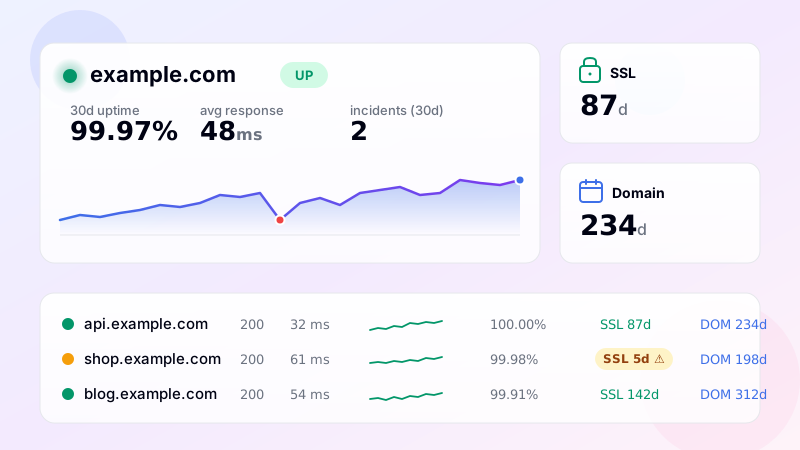
Uptime monitoring that catches what others miss
Uptime monitoring polls your websites, APIs, and services on a schedule. It alerts you when they stop responding. The basic case — checking if a page loads — is easy. Any tool does it.
The hard cases are where real downtime hides:
- HTTPS certificate expires at midnight on Sunday
- Domain lapses because the registrar's card got rotated
- API returns HTTP 200 with corrupted JSON for three hours
- CDN silently changes IP and breaks DNS-pinned upstream
- Cron job stopped working last Tuesday and nobody knows
DiagnoSEO Uptime Monitoring handles all these cases in one tool. Checks run from 13 regions worldwide. Alerts route to email, Telegram, Slack, Discord, or SMS — wherever you actually look.
For SEO professionals, this doubles as SEO infrastructure monitoring. A domain that expires deindexes overnight. An SSL warning kills organic traffic. A broken redirect chain leaks link equity. The same tool that catches downtime also catches the silent issues that erode rankings.
What you get
- 11 monitor types — HTTP(S) website checks, keyword presence or absence, ping (TCP), TCP port, heartbeat and cron-job monitoring, custom HTTP API with method, headers, body and JSON assertions, multi-location checks from 13 countries, SSL certificate watchdog, DNS change detection, domain expiration tracking, and response time threshold alarms.
- Real-time alerts — email, Telegram, Slack, Discord, and SMS. A configurable confirmation period (consecutive fails) so a momentary blip does not wake you at 3 a.m. Quiet hours so you sleep. Recovery (UP) alerts so you know when it is safe to put the phone down.
- SSL and domain expiry warnings — automatic 30/14/7/3/1-day reminders before expiration. Color-coded pills in the dashboard. Never get caught by a midnight SSL expiry again.
- DNS change detection — alert when your A, AAAA, MX, NS, or CNAME records change. Useful for catching unauthorized DNS hijacks, accidental misconfiguration during migrations, or third-party providers updating endpoints without notice.
- Multi-location checks — verify your site is up from the US, UK, Germany, France, Italy, Spain, Poland, the Netherlands, Canada, Australia, Japan, Brazil, and India. Catches geo-routing issues, regional DNS problems, and ISP-level blocks.
- 30-day uptime bar chart and sparkline — see at a glance which sites have stability problems. Each daily bar is color-coded (green ≥99%, light green ≥95%, orange ≥50%, red <50%). The sparkline shows the last 50 response times with red dots marking outages.
- SLA reports — exportable CSV with uptime percentage, total downtime minutes, incident count, and mean time to recovery. Per monitor and aggregated.
- Heartbeat and cron-job monitoring — instead of pinging your server, your cron job pings us. If we do not hear from it within the expected window plus a grace period, we alert you. Catches silent cron failures (locked-out user, broken script, full disk) that traditional uptime monitoring misses.
- Bulk add via paste — drop 100 URLs into a textarea, press Save. Each line can include
keyword:,interval:,tag:, andname:parameters. No CSV gymnastics. - Tags and filters — group monitors by environment (prod, staging), team (api, marketing), or criticality (critical, optional). Filter the dashboard down to what matters right now.
- Browser-side queue processor — when you click "Check all now", the browser processes the queue in batches of 20, in parallel with the cron. So 200 monitors get checked in about 1 minute total, not 30 minutes.
- JSON assertions — for API monitoring:
data.statusmust equalok,result.countmust be> 0, and so on. Catches APIs that return HTTP 200 with malformed payloads (the worst kind of broken).
Who uses uptime monitoring
E-commerce shops
Every minute of downtime is direct revenue loss. Monitor checkout endpoints, payment gateways, and product pages. SSL expiry alerts prevent the trust warning that kills conversion. Multi-region checks catch geo-routing problems where the site works for you but not for customers in the US or Japan.
SaaS and B2B platforms
SLAs are contractual. Track API uptime per endpoint, JSON response correctness, and response time thresholds. SLA reports export the numbers your customers ask for. Heartbeat monitors catch silent background-job failures that traditional uptime tools miss entirely.
SEO agencies and in-house SEO teams
The pages you rank for need to stay up — Google penalizes flaky sites. Domain expiry triggers a deindex within days. SSL warnings tank trust signals and CTR. Track every domain in your portfolio for uptime, SSL, domain expiry, and DNS changes that signal an attack. Combine with DiagnoSEO's keyword and backlink tools for a single dashboard covering infrastructure and rankings.
DevOps and SRE teams
Multi-region HTTP, TCP port, ping, and DNS-change checks for the full infrastructure stack. Confirmation periods and quiet hours prevent alert fatigue. Telegram, Slack, and Discord integrations route alerts to the right channel. SSL and domain expiry tracking catches the silent failures.
Uptime monitoring vs UptimeRobot, Pingdom, BetterStack, Oh Dear, Site24x7, and StatusCake
The major competitors all do basic HTTP uptime well. Where they diverge is in adjacent features: SSL warnings, domain expiry tracking, DNS change detection, multi-region coverage from non-Western regions, JSON assertions, cron-job heartbeats, and free plan limits.
Below is a side-by-side comparison based on each tool's published pricing. Verify against the vendor's current page before making a buying decision. For detailed head-to-head breakdowns, see the per-competitor comparison pages linked below the table.
| Feature | DiagnoSEO | UptimeRobot | Pingdom | BetterStack | Oh Dear | Site24x7 | StatusCake |
|---|---|---|---|---|---|---|---|
| Free plan | 5 monitors (preview) | 50 monitors, 5-min | ❌ | 10 monitors, 3-min | ❌ Paid only | 5 monitors basic | 10 monitors, 5-min |
| Minimum interval | 1 minute (Pro+) | 1 min (paid) | 1 min | 30 sec | 1 min | 1 min | 5 min (free), 30 sec (Business) |
| SSL expiry alerts | ✅ 30/14/7/3/1d | ✅ | ⚠️ Add-on | ✅ | ✅ | ✅ | ✅ |
| Domain expiry | ✅ Included | ❌ | ❌ | ❌ | ⚠️ Limited | ✅ Web Pro+ | ✅ Built-in |
| DNS change alerts | ✅ Included | ❌ | ❌ | ⚠️ Partial | ⚠️ History only | ✅ | ⚠️ Limited |
| JSON assertions | ✅ | ⚠️ Keyword only | ⚠️ Transaction $ | ✅ | ⚠️ Limited | ✅ | ⚠️ Keyword only |
| Heartbeat / cron | ✅ Included | ⚠️ Add-on | ❌ | ✅ | ✅ Laravel-first | ✅ | ✅ Push monitors |
| Backlink monitoring | ✅ Enterprise | ❌ | ❌ | ❌ | ❌ | ❌ | ❌ |
| SEO suite bundled | ✅ Full SEO toolkit | ❌ | ❌ | ❌ | ❌ | ❌ | ❌ |
| Multi-region | 13 regions | Multi-region | 100+ regions | Multi-region | Multi-region (EU-focused) | ~130+ regions | 43 locations / 30 countries |
| Telegram alerts | ✅ | ✅ | ❌ (Slack only) | ✅ | ✅ | ⚠️ Limited | ✅ |
Frequently asked questions
-
It depends on your check interval and confirmation threshold. On Pro and Enterprise plans the check runs every 1 minute. The default confirmation threshold is 2 consecutive failures, so a sustained outage triggers an internal status change within about 2 minutes.
Email alerts are throttled to 2 hours of sustained downtime to suppress short flaps. Short outages stay quiet; real outages get notified. Telegram, Slack, Discord, and SMS can be configured to fire on the immediate status change instead.
-
Uptime monitoring polls a single endpoint and verifies the response (status code, content, JSON shape). Synthetic monitoring runs multi-step browser scripts: log in, navigate, click checkout, fill a form.
DiagnoSEO does uptime monitoring with deep response inspection (HTTP method, headers, body, JSON assertions, keyword presence). It does not do full browser scripting. For the majority of "is the site working" questions, this is the right tool. For multi-step user journey testing, use a dedicated synthetic tool alongside.
-
Yes — directly. Google's crawlers treat extended downtime as a quality signal. A site that fails to respond for hours during Googlebot crawls loses crawl budget and may have pages deindexed.
Beyond raw uptime, the related signals matter just as much. Expired SSL certificates cause browser warnings that tank click-through rates. An expired domain triggers DNS NXDOMAIN responses that drop all rankings within days. A misconfigured redirect chain leaks link equity. Treating monitoring as part of SEO infrastructure (not just sysadmin tooling) catches these issues before they cost rankings.
-
Because auto-renewal silently fails more often than people expect. Common causes:
- Let's Encrypt rate limits hit during deployment
- Certbot misconfiguration after a server upgrade
- DNS-01 challenges failing because a CNAME got removed
- Expired credit card on a commercial CA account
All of these break renewal without throwing a visible error until the existing cert expires. SSL monitoring catches the silent failure 30 days before users do.
-
Yes. Configure the monitor with custom HTTP headers — typically an
Authorizationheader with a Bearer token or API key. Header values are encrypted at rest in the database.For Basic Auth, there is a dedicated username/password field that signs the request automatically. For OAuth flows that need token refresh, use a long-lived service token or rotate the monitor's stored header on your end when needed.
-
You provide a string (or HTML fragment). The monitor fetches the response body and checks whether the string appears as a substring. Both plain text ("Add to cart") and HTML snippets (
<button class="buy">) work.Two modes:
- Must be present — fail if missing. Useful for verifying that page content loaded correctly.
- Must be absent — fail if present. Useful for catching error pages that return HTTP 200, or detecting unauthorized content on your domain.
-
No. Failed and successful checks cost the same — a check is a check regardless of outcome. Manual rechecks (the Refresh button) are free and do not draw from your check budget.
WHOIS lookups for domain expiry are limited to once per 24 hours per domain to keep API costs predictable. The Force Fresh button bypasses this cap when you need an immediate re-check.
-
The domain expiry monitor will have warned you 30, 14, 7, 3, and 1 days out via email — plus Telegram, Slack, and Discord if you have those configured.
If you ignore all warnings and the domain expires, the HTTP monitor starts failing (DNS resolution returns NXDOMAIN). You will get a DOWN alert after the 2-hour sustained-failure threshold. At that point the domain is in the registrar's grace period (typically 30 days for most TLDs) and renewal is still possible.
-
DiagnoSEO Uptime Monitoring stores monitor configuration (URLs, headers, keyword strings) encrypted at rest using AES-256. Check results (response codes, timing, error messages) are stored for the retention period defined by your plan.
No personally identifiable end-user data is collected from your monitored sites. The monitor reads only HTTP response headers and the body string you configured a keyword check against. Data is hosted in EU data centers. Full DPA is available on request.
Compare DiagnoSEO with specific alternatives
Each comparison page covers feature parity, honest assessment of where the competitor wins, pricing breakdown, and step-by-step migration instructions.
DiagnoSEO vs UptimeRobot
The most-searched alternative. Covers the 2024 free-plan commercial-use restriction, why domain expiry tracking matters, and how the SEO bundle changes the cost calculation.
DiagnoSEO vs Pingdom
SolarWinds-owned legacy tool. Compares the enterprise-grade region coverage (70+) and RUM features against DiagnoSEO's narrower scope and lower price.
DiagnoSEO vs BetterStack
BetterStack (formerly Better Uptime) excels at incident management and log aggregation. When that PagerDuty-style workflow is not what you need, the price gap is significant.
DiagnoSEO vs Oh Dear
Oh Dear is the Laravel community's favorite. Honest assessment of broken-link checking (Oh Dear wins), Telegram alerts (DiagnoSEO wins), and platform-agnostic vs Laravel-first design.
DiagnoSEO vs Site24x7
Site24x7 is the Zoho/ManageEngine enterprise observability suite. Compares the breadth of features (servers, APM, network) against DiagnoSEO's focused approach and 5-minute onboarding.
DiagnoSEO vs StatusCake
StatusCake is a UK-based monitoring tool (since 2012) with page-speed and server monitoring built in. Compare the free-tier coverage, status-pages-sold-separately pricing model, and where DiagnoSEO's SEO bundle changes the math.
DiagnoSEO vs Sentry
Sentry's strength is error tracking and APM — uptime and cron monitoring are add-ons billed per monitor on top of the base plan.
DiagnoSEO vs Uptrends
Uptrends is enterprise synthetic monitoring with 230+ checkpoints but locks you into a 12-month contract with 90-day cancellation notice.
DiagnoSEO vs Cronitor
Cronitor specializes in cron-job monitoring with a per-monitor + per-user pricing model, and charges separately for branded ($25/mo) and private ($50/mo) status pages.
DiagnoSEO vs New Relic
New Relic is full-stack observability (APM, logs, infrastructure, synthetics) priced by user count and GB ingest — overkill if you only need uptime monitoring.
Explore features in depth
Each feature has a dedicated deep-dive page covering setup, technical detail, and edge cases.
SSL monitoring
How TLS certificate expiry tracking works, the 30/14/7/3/1-day warning thresholds, and why auto-renewal alone is not enough.
Domain expiry
WHOIS-based monitoring that warns 30 days before a domain expires, including handling of registrar grace periods and the .pl deletion-date case.
DNS monitoring
Detect changes to A, AAAA, MX, NS, CNAME, TXT, SPF, DMARC, and CAA records — for DNS-hijack detection and routine config audits.
Ping (ICMP)
ICMP-level reachability checks for routers, servers, and devices that do not run HTTP services.
Port (TCP)
Check that a specific TCP port is open and accepting connections — useful for SSH, FTP, SMTP, database, and game servers.
Endpoint
Generic TCP-endpoint reachability checks for any service where you care about availability but do not need protocol-aware probing.
Keyword
Verify a string appears (or does not appear) in the response body — catches error pages returning HTTP 200 and content-loss regressions.
API
JSON path assertions, custom HTTP methods, Bearer-token headers, and Basic Auth — for REST and GraphQL endpoints that need deep response inspection.
Cron / Heartbeat
Inverted monitoring — your job pings us when it succeeds. Catches silent background-task failures that traditional uptime tools miss.
Response time
Threshold-based slow-response alerts with confirmation counts that suppress brief spikes while catching sustained latency regressions.
Backlink
Track the availability and health of pages linking to you — uptime applied to your off-site SEO assets.
Location-specific
Run checks from specific geographic regions to verify CDN routing and detect geo-targeted outages.
Website monitoring
Big-picture guide to combining HTTP, SSL, domain, and DNS monitoring into a single SEO-infrastructure stack.