
New Relic Alternative
New Relic is full-stack observability priced by user count and GB ingest — overkill if you only need website uptime monitoring. DiagnoSEO is the focused alternative with flat per-month pricing and no surprise bills.
Try DiagnoSEO Uptime Monitoring →
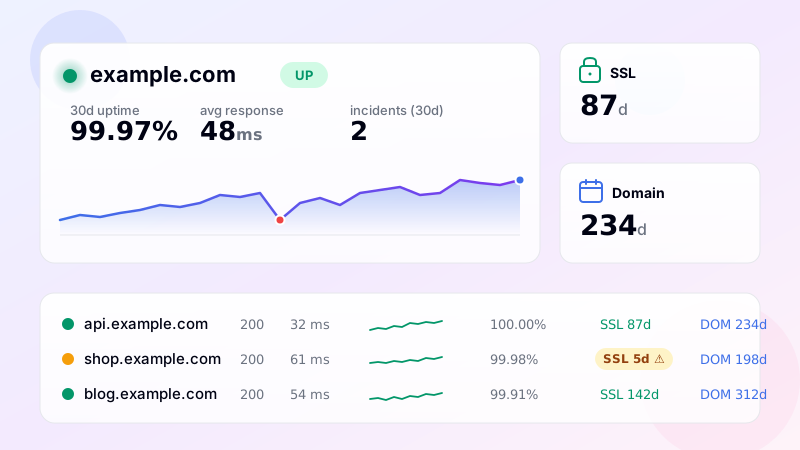
Why people look for a New Relic alternative for uptime
New Relic is a full-stack observability platform — APM with distributed tracing, infrastructure monitoring, browser monitoring, mobile, synthetics, log management, AIOps, 50+ capabilities. Synthetic monitoring (which includes uptime checks) is one of those capabilities, not the focus. Used by 16,000+ organizations, mostly enterprise.
Where it does not fit a website-monitoring use case:
- 500 synthetic checks/month on free, 10,000 on paid plans. Looks generous until you multiply: 10 endpoints × every minute × 3 regions = 1.3M checks/month, far over the included quota. Overage is $0.005 per check, but the math gets uncomfortable fast.
- Full Platform users are expensive. $49/user for Core, $349-418/user for additional Full Platform users beyond the first one (which is free). For a small team that all needs to debug, the user cost dominates the bill.
- $0.40/GB ingest after 100 GB free. APM + logs + infrastructure metrics for a medium-traffic app commonly hits 150-200 GB/month. The Vercel cold-start penalty (200-400ms) from the Node.js agent is another commonly-cited concern.
- Bill predictability is a known pain. The G2 reviews and pricing analyses repeatedly flag "sticker shock" when usage scales. New Relic's complexity is enterprise-grade, and so is the operational cost of managing it.
- No SSL day countdown, no WHOIS-based domain expiry, no DNS A/MX/NS diff alerts. Synthetic monitors can probe HTTPS, but the "30 days till SSL expires" and "your domain renewal is 7 days out" framing isn't there. SEO-specific features (keyword presence, backlink tracking) aren't part of the product.
DiagnoSEO Uptime Monitoring is the inverse: small surface area (uptime + SSL + domain + DNS + keyword + heartbeat), flat plan pricing, no GB-ingest surprises, no per-user multipliers. The user is a website owner or SEO operator, not an SRE building an observability platform.
Feature comparison
| Feature | DiagnoSEO | New Relic |
|---|---|---|
| Free plan | 5 monitors (preview) | 100 GB ingest + 500 synthetic checks/mo |
| Entry paid pricing | From $7/mo (flat) | $49/user + $0.40/GB ingest |
| Synthetic check quota | Plan-based (no per-check fee) | 500 free, then $0.005/check |
| Per-user pricing | No | Yes ($49 Core, $349+ Full Platform) |
| Data ingest billing | No | $0.40/GB beyond 100GB |
| Minimum check interval | 1 minute (Pro+) | 1 minute (synthetic) |
| SSL expiry alerts | ✅ 30/14/7/3/1d | ⚠️ Via custom alert |
| Domain expiry tracking | ✅ Included | ❌ |
| DNS change detection | ✅ Full diff | ❌ |
| Keyword presence/absence checks | ✅ | ⚠️ Via custom check |
| Heartbeat / cron monitoring | ✅ Included | ⚠️ Via synthetic |
| Backlink / referring domains | ✅ Enterprise | ❌ |
| APM / distributed tracing | ❌ | ✅ Core product |
| Log management | ❌ | ✅ |
| Infrastructure monitoring | ❌ | ✅ |
When New Relic is still the right call
If you run application infrastructure at scale — multiple services, Kubernetes clusters, distributed tracing across microservices, deep performance debugging — New Relic is built for that and there are few realistic substitutes. The free tier (100 GB + 1 Full Platform user) is genuinely usable for a small team running a moderate-traffic app.
Pick DiagnoSEO when your problem is the website on the public internet — is it up, is the SSL valid, is the domain about to expire, has DNS been tampered with, is the keyword still in the response — not the application internals.
FAQ
-
No. DiagnoSEO is an external monitor — it makes HTTP requests to your site and reports what it sees. APM (instrumenting your code to trace requests internally) and distributed tracing are out of scope. For those, keep New Relic and use both — they cover different parts of the stack.
-
No. DiagnoSEO uses flat plan-based pricing. There is no ingest meter, no $0.40/GB beyond 100GB, no per-check overage. The check quota included in each plan tier is the limit; if you exceed it, the suggestion is to move up a tier or rethink check frequency, not to absorb a usage-based bill.
-
Yes — they cover different surfaces. New Relic instruments your application code from inside; DiagnoSEO probes the website from outside. Use New Relic for APM, logs, infrastructure; use DiagnoSEO for external uptime, SSL, domain, DNS, and SEO-specific checks.
UptimeRobot · Pingdom · BetterStack · Oh Dear · Site24x7 · StatusCake · Sentry · Uptrends · Cronitor
SSL monitoring · Domain expiry · DNS monitoring · Ping (ICMP) · Port (TCP) · Endpoint · Keyword · API · Cron / Heartbeat · Response time · Backlink · Location-specific · Website monitoring