
Pingdom Alternative
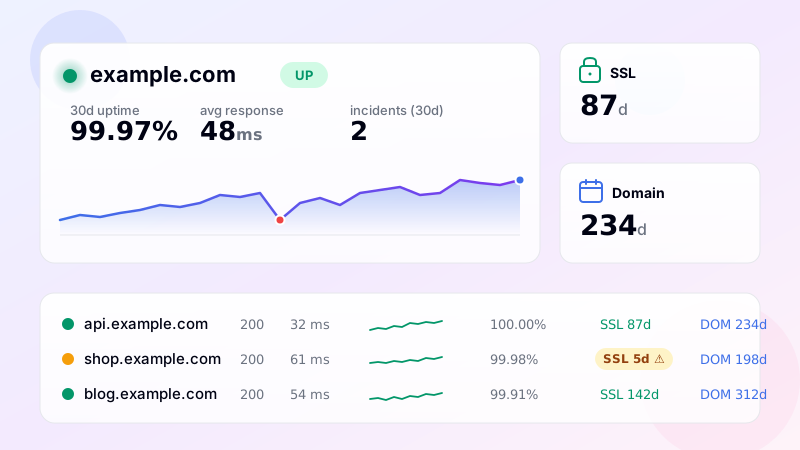
Pingdom is solid but pricey, with no free tier and a corporate UX. DiagnoSEO offers comparable uptime monitoring at a fraction of the price, plus SSL, domain, DNS and SEO bundled.
Try DiagnoSEO Uptime Monitoring →
Why people look for a Pingdom alternative
Pingdom is the established name. SolarWinds-owned, around since 2007, used by enterprise teams that have always used Pingdom. For deep technical uptime monitoring it is solid.
The reasons people start looking elsewhere:
- Pricing starts at $15/mo with no free tier. For somebody monitoring a personal blog or a handful of small sites, that is steep for a single feature.
- The interface feels dated. SolarWinds-era enterprise UX, designed for monitoring teams, not for the developer or marketer who just wants to check whether the site is up.
- Real user monitoring is the upsell. Pingdom's pitch is the full APM-style stack — synthetic transaction monitoring, RUM, the works. If you only need uptime and SSL, you are paying for things you do not use.
- No domain expiry or DNS change detection. Like UptimeRobot, the focus is on HTTP uptime. SSL expiry alerts work; domain expiry and DNS changes are out of scope.
DiagnoSEO Uptime Monitoring is positioned differently: bundled with a full SEO toolkit, focused on the "is my site healthy from a search-engine point of view" angle, with uptime as one piece. Pricing starts at $7/mo for the whole platform, and there is a free tier (5 monitors, no commercial-use restriction).
Feature comparison
| Feature | DiagnoSEO | Pingdom |
|---|---|---|
| Free plan | 5 monitors (preview) | ❌ Tylko paid |
| Entry pricing | From $7/mo (full suite) | From $15/mo (uptime only) |
| Minimum check interval | 1 minute (Pro+) | 1 minute |
| Multi-region checks | 13 regions | 100+ regions |
| SSL expiry alerts | ✅ 30/14/7/3/1d | ✅ (add-on) |
| Domain expiry tracking | ✅ Included | ❌ |
| DNS change detection | ✅ Included | ❌ |
| JSON assertions for API monitoring | ✅ | ⚠️ Transaction (extra) |
| Heartbeat / cron-job monitoring | ✅ Included | ❌ |
| Bulk add via paste | ✅ (100+ URLs) | ⚠️ Limited |
| Telegram alerts | ✅ (included) | ❌ (tylko Slack) |
| Discord alerts | ✅ | ❌ |
| SMS alerts | ✅ | ✅ (paid credits) |
| Public status pages | Coming soon | ✅ Premium |
| SEO suite bundled | ✅ Keyword + backlinks + audit | ❌ |
| Real user monitoring | ❌ | ✅ Premium |
| Synthetic transaction monitoring | ❌ | ✅ Premium |
Where DiagnoSEO wins
Price. $7/mo gets you uptime monitoring plus a full SEO toolkit. Pingdom starts at $15/mo for uptime alone, with synthetic monitoring and RUM as separate paid features. For teams that do not need real user monitoring or browser scripting, DiagnoSEO is dramatically cheaper.
Free tier. 5 monitors free with no commercial-use restriction. Pingdom has no free option at all — you start paying on day one.
Domain expiry and DNS change detection. Bundled into every check. Pingdom only watches HTTP and SSL. For somebody managing a portfolio of domains, missing the WHOIS expiry warning means lost rankings (and sometimes lost domains).
SEO infrastructure framing. Pingdom is a tool for ops people. DiagnoSEO is a tool for anyone whose job depends on organic traffic — combining uptime with the ranking and backlink data in one dashboard.
Telegram and Discord built in. Pingdom routes through email or Slack; for teams running on Telegram or Discord, it is a friction point or a custom integration. DiagnoSEO supports both natively.
Where Pingdom wins
Region coverage. 100+ check locations worldwide versus 13 on DiagnoSEO. If you need to verify geo-routing for users in obscure regions (parts of Africa, less common South American countries, multiple Asian POPs), Pingdom is the more thorough option.
Real user monitoring. Pingdom collects performance data from actual browser sessions in production — TTFB, FCP, LCP, broken by device and geography. DiagnoSEO does not offer RUM. If you need to measure real user performance (not just whether the server responds), Pingdom's premium tier is the right tool.
Synthetic transaction monitoring. Pingdom can script multi-step browser scenarios: log in, navigate, add to cart, complete checkout. DiagnoSEO is limited to single-endpoint checks with deep response inspection. For a complex multi-step user journey, you would need a dedicated synthetic tool alongside DiagnoSEO.
Enterprise integrations. ServiceNow, PagerDuty (free in DiagnoSEO via webhook, but Pingdom has tighter integration), Splunk, Datadog — the SolarWinds ecosystem connects well to enterprise observability stacks.
Migration from Pingdom to DiagnoSEO
- Export monitor list from Pingdom. Settings → Account → Export. Pingdom's CSV includes monitor name, URL, type, interval, and notification rules.
- Open DiagnoSEO bulk add. Click "Add monitor" → "Bulk add" tab. Paste URLs from the Pingdom CSV.
- Optional per-line parameters:
https://example.com keyword:Order interval:1 tag:prod name:Checkout API— sets keyword check, interval, tags, and display name in one line. - Configure notifications. Add your Telegram chat ID, Slack webhook, or Discord webhook. DiagnoSEO will fire DOWN, UP, SSL warning, and domain expiry alerts to those channels.
- If you use Pingdom for synthetic monitoring (multi-step browser scripts): DiagnoSEO does not replace that. Keep Pingdom (or a synthetic-only tool) for those specific scenarios; move basic uptime + SSL + domain + DNS to DiagnoSEO and downgrade your Pingdom plan.
- Run in parallel for one week. Verify alerts arrive. Then cancel Pingdom or downgrade.
Frequently asked questions
-
Pingdom's entry plan is $15/mo for 10 monitors and basic uptime. DiagnoSEO Basic is $7/mo and includes uptime monitoring plus the full SEO suite (keyword tracking, backlink monitoring lite, site audits). For uptime-only use, DiagnoSEO is roughly half the price; if you would also pay for an SEO tool separately, the savings compound.
-
No. DiagnoSEO does server-side uptime checks: it sends requests on a schedule and verifies the response. RUM (real user monitoring), which collects performance data from actual browser sessions, is not in scope. For RUM, Pingdom or a tool like Cloudflare Web Analytics is the right choice.
-
No. DiagnoSEO is single-endpoint checks with deep response inspection (HTTP method, headers, body, JSON assertions, keyword check). For multi-step browser automation (login + navigate + checkout), use a synthetic monitoring tool alongside DiagnoSEO.
-
13 regions cover the major continental zones (North America, South America, Europe, Asia, Australia). For most teams this is enough — a site that fails from 13 different regions is reliably down, not a geo-routing issue. Pingdom's 100+ regions matter when you need to verify performance from specific minor ISPs or less common locations. For typical SaaS or e-commerce use, the 13-region coverage is sufficient.
-
No. Pingdom tracks SSL certificate expiry (since 2019) but does not check WHOIS for domain expiration. If your domain lapses, Pingdom only notices when the resulting HTTP failures trigger a downtime alert — by which point you are already in the registrar grace period. DiagnoSEO does a 24-hour WHOIS check on every domain and warns 30/14/7/3/1 days out.
UptimeRobot · BetterStack · Oh Dear · Site24x7 · StatusCake · Sentry · Uptrends · Cronitor · New Relic
SSL monitoring · Domain expiry · DNS monitoring · Ping (ICMP) · Port (TCP) · Endpoint · Keyword · API · Cron / Heartbeat · Response time · Backlink · Location-specific · Website monitoring